
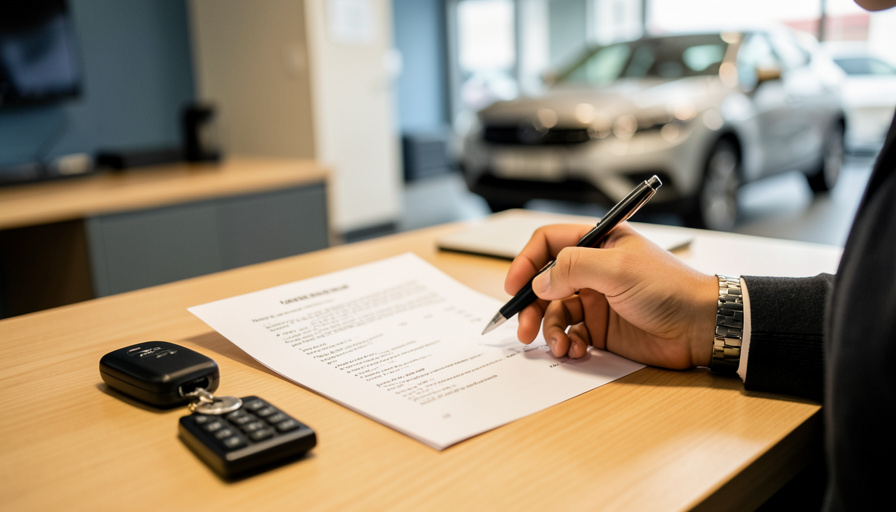
Buying out your lease should cost the number in your contract plus taxes, not a pile of dealer add-ons. Here’s which fees are real and which you can cross out.
You already know the car, you like the car, and your lease has a buyout price printed in the contract. So why does the dealer’s quote suddenly run hundreds or thousands more? The answer is fees, some legitimate and some invented, stacked onto a price that was supposed to be simple. A lease buyout is one of the few car transactions where you hold most of the cards, because the core numbers are fixed in your own contract. That makes it easy to spot padding once you know what belongs and what does not. Here is exactly which lease buyout fees are legitimate, which to reject, and how to compare quotes without getting talked into extras.
What To Know
A lease buyout should cost four things: the residual value set when you signed the lease, the purchase option fee named in that same contract, usually 300 to 500 dollars, sales tax on the purchase, and government title and registration fees. That is it. Everything else is negotiable or refusable. Documentation fees are often not owed on a buyout unless your lease contract specifically allows them, and dealer add-ons like paint protection, VIN etching, extended warranties, and any “market adjustment” have no place on a car you already have. Get an itemized quote, compare it against your contract, and cross out any line that is not in the contract or a real government charge.
What a lease buyout should actually cost
Start with the legitimate numbers, because they are already written down. Your residual value, the price to buy the car, was set when you signed the lease and does not change. Your purchase option fee, typically a few hundred dollars, is also stated in the contract. On top of those, you pay sales tax on the purchase price at your state’s rate, and the standard title and registration fees any car purchase carries. Those four items are the real cost of a buyout, and every one of them is either in your lease contract or a government charge you can verify. The FTC’s overview of financing or leasing a car is a good reference for how these terms work.
The fees to question or reject
Now the padding. When a buyout quote runs well above your contract math, the extra is almost always one of these.
- Add-on products. Paint or fabric protection, VIN etching, nitrogen-filled tires, and dealer prep packages are optional, and pointless on a car you have driven for years. Decline them.
- Extended warranty or GAP. These may have value, but they are your choice, not a required part of a buyout. Never let one be slipped in as mandatory.
- Reconditioning fees. A dealer cannot bill you to recondition the car you already own and are buying. This charge does not belong on a buyout.
- “Market adjustment” or markup. Your price is the contract residual. A market-based markup on your own leased car is not a real buyout cost.
- A doc fee your contract never authorized. More on this next, but treat any documentation fee with suspicion until you confirm it is allowed.
The documentation fee trap
Doc fees deserve their own warning because they are the most abused line on a car deal. They vary enormously by state, from tightly capped amounts to well over a thousand dollars where no cap exists, and dealers add them almost by reflex. The key point for a buyout is that a documentation fee is usually not contractually owed unless your lease specifically states it. So before you accept one, read your lease for language authorizing it. If it is not there, question the fee, and be ready to push back or walk if the dealer will not remove or reduce it. A fee that is not in your contract and is not a government charge is one you can dispute.
How to compare buyout quotes
Comparison is where you take back control. First, do the math yourself: residual plus purchase option fee plus tax plus title and registration is your baseline. Then insist on an itemized quote, not a single lump sum, so you can see every line. Compare each line to your baseline and to your lease contract, and challenge anything that does not match. It is also worth pricing a buyout loan through your own bank or credit union, which can let you complete the purchase without the dealer’s add-on pressure, though check first whether your leasing company allows a third-party payoff. Regulators continue to scrutinize deceptive auto fees, as the FTC signals through its work on the auto marketplace, but the fastest protection is your own itemized comparison.
This article is general information, not financial or legal advice. Lease terms, fees, and tax rules vary by contract and state and can change, so review your specific lease agreement and confirm charges with the leasing company or a professional before you buy out a lease.
Frequently Asked Questions
What fees are legitimate on a lease buyout?
The residual value from your lease, the purchase option fee stated in the contract, sales tax on the purchase, and government title and registration fees. Those four are the real cost. Anything else should be questioned against your contract.
Do I have to pay a documentation fee on a lease buyout?
Often not. A doc fee is usually only owed if your lease contract specifically authorizes it. Read your lease, and if it is not there, question the charge and be prepared to push back or take your buyout elsewhere.
Can a dealer add a market adjustment to my buyout price?
No. Your buyout price is the residual value fixed in your lease, so a market-based markup on a car you already lease is not a legitimate buyout cost. Decline it and hold the dealer to the contract number.
Should I buy the extended warranty or GAP at buyout?
Only if you decide they are worth it. They are optional products, never a required part of a buyout, so do not let either be presented as mandatory. Evaluate them on their own merits, separately from the purchase.
How do I compare lease buyout quotes fairly?
Calculate your baseline of residual plus purchase option fee plus tax plus title and registration, then get an itemized quote and compare every line to it and to your lease. Challenge anything that does not match, and consider a credit-union buyout loan.
Can I finance a lease buyout through my own bank?
Often yes, which can help you avoid dealer add-on pressure. Check first whether your leasing company permits a third-party payoff, since some restrict it, then compare the loan terms to any dealer financing.
Final Word
A lease buyout is a rare car deal where the important numbers are already yours. The residual and the purchase option fee are in your contract, taxes and registration are set by the state, and that is the whole legitimate bill. Every add-on, every reconditioning or market-adjustment line, and any doc fee your lease never authorized is negotiable or refusable. Ask for an itemized quote, check it against your contract, and cross out what does not belong. Do that and you buy the car you already know at the price you were actually promised, not the padded one on the first quote. For more, see what is happening with car prices and how to fix CarPlay that keeps disconnecting.

Leave a Reply
You must be logged in to post a comment.