
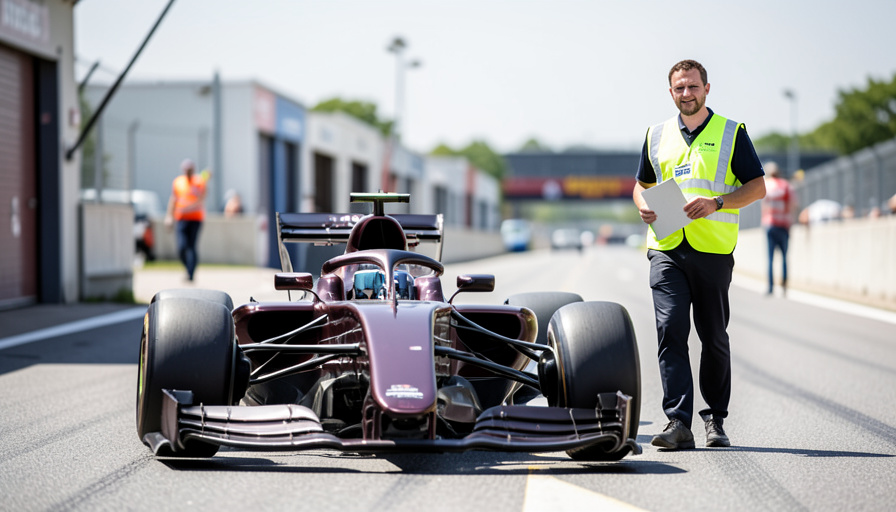
A five-second penalty can cost a win. A points tally you cannot see can end a season. Here is the full menu of F1 penalties, and how stewards decide which one applies.
Modern Formula 1 is decided as often in the stewards’ room as it is on the track. A driver crosses the line first and loses the race an hour later. Another qualifies on pole and starts tenth. If you have ever watched that happen and wondered what the rulebook was actually doing, this is a plain-English tour of how F1 penalties work, from the mildest warning to a full race ban.
The system looks tangled from the outside, but it follows a rough ladder of severity. Once you can see the rungs, the decisions make a lot more sense.
The Short Version
F1 penalties climb a ladder: a warning or reprimand, then in-race time penalties of five or ten seconds, then a drive-through or stop-and-go, then grid drops for the next race, and at the top, disqualification and a race ban. Separately, drivers carry penalty points on their superlicence, and 12 points within 12 months triggers an automatic one-race ban. Stewards pick the rung based on how serious and how deliberate the offence was.
Table of Contents
The Ladder of F1 Penalties
Almost every penalty in Formula 1 fits somewhere on a scale from a gentle nudge to being thrown out entirely. At the bottom sit warnings and reprimands, which carry no immediate time cost but stack up. In the middle are the in-race penalties that decide most races. At the top are grid penalties, disqualification, and bans.
Which rung a driver lands on comes down to two questions the stewards keep asking: how dangerous was it, and how much was it the driver’s fault? A racing incident that hurt no one draws nothing. The same contact, judged reckless, can cost ten seconds and points on a licence.
In-Race Penalties: Time, Drive-Through, and Stop-Go
These are the ones that swing a Sunday. Stewards use them for offences committed during the race itself, like causing a collision, leaving the track and gaining an advantage, or speeding in the pit lane.
- Five-second and ten-second time penalties. The most common. The driver either serves the wait at their next pit stop before the crew can touch the car, or has the seconds added to their total race time at the end.
- Drive-through penalty. The driver must enter the pit lane, drive through at the speed limit, and rejoin without stopping. It costs roughly 20 seconds depending on the circuit.
- Stop-and-go penalty. The harshest in-race option. The driver stops in their box for a set time, usually ten seconds, with no work allowed on the car, then rejoins.
The detail people miss is the “no work on the car” rule during a served time or stop-go penalty. It means the team cannot fold the penalty into a normal tyre change, which is exactly what makes it hurt.
Grid Penalties: Paying Next Time
Some offences do not fit into the current race, so the cost is carried to the next one as a grid drop. A driver might qualify third and start eighth. The two big sources are mechanical and behavioural.
On the mechanical side, teams get a fixed allocation of power-unit parts for the season. Go over it, usually because an engine failed, and the driver takes a grid penalty at the next race. On the behavioural side, reprimands stack: collect five reprimands, at least four of them for driving, and it converts to a 10-place grid penalty. Grid drops are the league’s way of punishing something that a time penalty cannot cleanly capture.
Penalty Points and the Superlicence
Running quietly under all of this is a system most fans cannot see mid-race. Every driver holds an FIA superlicence, and stewards can add penalty points to it for driving offences, between one and three per incident. Reach 12 points inside a rolling 12-month window and the driver serves an automatic one-race ban. Points expire 12 months after they are issued, so the tally is always moving.
This is where 2026 brought a real change. The FIA reformed the criteria so points are now reserved for dangerous, reckless, or unsportsmanlike incidents, rather than ordinary racing contact. The effect has been striking: through the early part of the 2026 season, not a single penalty point had been issued, a sharp break from previous years, as motorsport reporting noted. Drivers had complained for years that points were being handed out for hard but fair racing, and the reset was the FIA’s answer.
Disqualification: When the Car Itself Is Illegal
Time penalties and grid drops punish how a driver races. Disqualification usually punishes the car. If post-session checks find the car broke a technical rule, the result is wiped regardless of how the driver drove or whether it helped.
Common causes include excessive wear on the plank under the floor, a car found underweight, a fuel-sample failure, or a fuel-flow breach. That last one has caught several drivers over the years, and it works differently enough to be worth its own explanation, which we covered in why F1 cars get disqualified for fuel-flow breaches. The throughline is simple: a technical breach is treated as absolute, so “it gave no advantage” is not a defense.
Who Decides, and How
Every race weekend has a panel of stewards, and one of them is a former driver brought in to add on-track perspective. They review video, telemetry, and radio, hear from the teams, and issue a decision. Most penalties are announced during or shortly after a session.
Teams are not entirely without recourse. They can request a review if genuinely new evidence appears, and in rare cases a decision goes to the FIA’s International Court of Appeal. But the bar is high, and most stewards’ calls stand. The practical takeaway for a fan watching live: when the graphic says “under investigation,” the ladder above is what the stewards are quietly climbing.
Key Takeaways
- F1 penalties follow a ladder: reprimands, time penalties, drive-through, stop-and-go, grid drops, disqualification, and bans.
- Five and ten-second time penalties decide most races, and no work on the car is allowed while one is served.
- Grid penalties carry a cost to the next race, from engine-part limits or stacked reprimands.
- Twelve superlicence points in 12 months means an automatic one-race ban, but 2026 narrowed when points apply.
- Disqualification punishes an illegal car, and a technical breach counts even with no performance gain.
Frequently Asked Questions
What is the most common penalty in F1?
The five-second time penalty is the most common. Stewards apply it for offences like causing a minor collision, gaining an advantage off track, or a pit-lane infraction. The driver serves it at a pit stop or has the time added to their race result.
How many penalty points get a driver banned in F1?
Twelve penalty points on the FIA superlicence within a rolling 12-month period trigger an automatic one-race ban. Points range from one to three per incident and expire 12 months after they are issued.
What changed about F1 penalty points in 2026?
The FIA narrowed the criteria so penalty points are issued only for dangerous, reckless, or unsportsmanlike incidents, not ordinary racing contact. Through the early 2026 season, no penalty points had been issued, a clear break from prior years.
Why do drivers get grid penalties?
Usually for exceeding the season’s allocation of power-unit parts, often after an engine failure, or for accumulating reprimands. Five reprimands, at least four for driving, convert to a 10-place grid drop at the next race.
Can an F1 penalty be appealed?
Teams can request a right of review if significant new evidence emerges, and some decisions reach the FIA’s International Court of Appeal. The threshold is high, though, and most stewards’ decisions stand as issued.
Final Word
The reason F1 penalties feel confusing is that they are trying to price very different things: a moment of danger, a mechanical failure, a pattern of rough driving, an illegal car. Once you sort them onto the ladder, the stewards’ logic gets clearer, and “under investigation” stops being a mystery and becomes a question of which rung. With the 2026 points reform still settling in, the interesting thing to watch this season is how much rougher the racing gets now that ordinary contact no longer costs a licence. For more racing coverage, see ShoutPost’s Sports section.



Leave a Reply
You must be logged in to post a comment.