
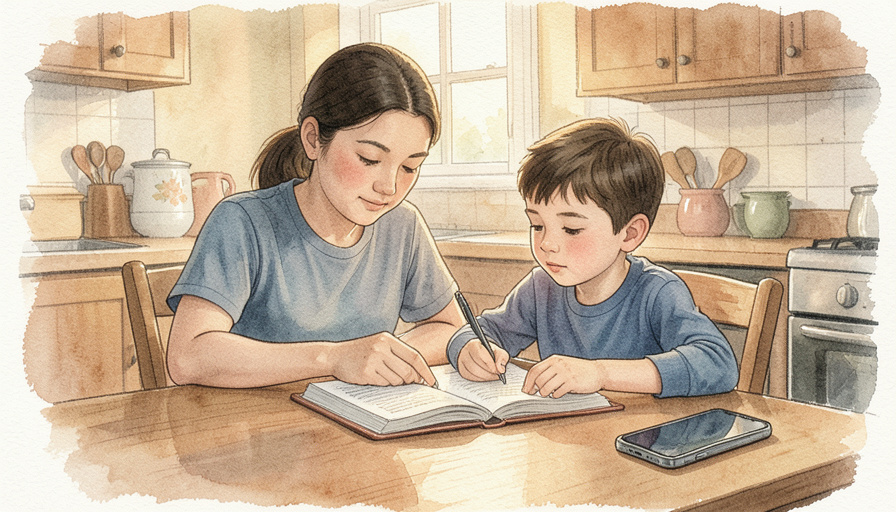
The 2025 PISA numbers are grim, but they are also specific. They point at reading comprehension and attention, which are two things you can actually work on at home.
When a report like PISA lands with words like “record low” attached, it is easy to feel a vague dread and then move on, because what is a parent supposed to do with an international test score? That reaction is understandable and also a missed opportunity. The 2025 OECD PISA results reaction from teachers and researchers went beyond alarm at the number. It offered a fairly precise diagnosis of what is slipping: deep reading, sustained focus, and the habit of thinking through a hard text instead of skimming it. Those are things a household can influence.
This is a practical guide, not another recap of the decline. If you want the news and the causes, we covered why the 2025 decline now looks structural and how countries compared in the rankings separately.
In Brief
The 2025 PISA results show that the sharpest declines are in reading comprehension and the focus it depends on, not basic decoding. For parents, the highest-value moves are protecting daily reading for meaning, capping heavy multitasking on screens, treating AI as a checking tool rather than a thinking substitute, and asking your child’s school specific questions about phones and how it teaches comprehension.
Table of Contents
What the Results Actually Tell Parents
Strip away the rankings and one finding matters most at home: the skills falling fastest are the higher-order reading skills. Not sounding out words, but understanding a passage, weighing it, and separating the important part from the noise. Officials pointed out that these are exactly the skills that matter more, not less, in a world where a chatbot will hand a child a confident answer in seconds.
So the practical translation of the 2025 results is narrower than the headlines suggest. Your child probably reads words fine. The question is whether they can tell you what a chapter argued and whether they believe it. That is the muscle that has weakened across a generation, and it is trainable.
The Reading Habit That Matters Most
Reading for meaning is built by reading a lot and then talking about it, not by drilling worksheets. The single most useful thing many families can do costs nothing: keep a steady flow of books your child actually wants to read, and ask about them like a curious person rather than a quiz master.
A few small habits do the heavy lifting:
- Ask what happened and what they thought. “What was the character trying to do, and did it work?” beats “Did you finish?” every time.
- Let them reread and abandon. Rereading a favorite builds fluency, and quitting a boring book protects the habit. Volume matters more than variety at first.
- Read slightly above their level together. A book a child cannot quite manage alone, read with you, stretches comprehension without frustration.
- Keep it print when you can. Print tends to invite slower, deeper reading than a scrolling screen, which is the mode PISA suggests is fading.
Where Screens Fit
The results do not say screens are evil. They say something more useful. Light-to-moderate device use tracked fine, but performance fell once daily digital time climbed past roughly three hours, and the bigger problem was a shift from creating on devices to passively consuming, according to the OECD’s PISA 2025 report.
That gives you two clean targets that beat a blanket ban. First, protect the homework hour from the phone. Divided attention while reading is where comprehension quietly dies, so a phone in another room during study time does more than any app timer. Second, tilt screen time toward making rather than scrolling. A kid editing a video, coding a small game, or writing is using a screen very differently from one who is three hours deep in a feed, and the outcomes reflect that.
Using AI Without Outsourcing the Thinking
Here is the trap the 2025 data hints at. If comprehension is the weak skill, and a chatbot can do the comprehension for a child, then leaning on AI makes the exact muscle that is failing weaker still. The fix is not to forbid the tools, since your child will use them anyway. It is to set the order of operations.
A simple rule works at home: think first, then check. Have your child write their own answer or summary before they open an AI tool, then use the tool to test and challenge it, not to produce it. “Ask the bot where your argument is weak” is a great prompt. “Ask the bot to write the essay” trains nothing. The goal is a sparring partner, not a ghostwriter.
What to Ask Your Child’s School
Parents often feel they have no real influence over the system-level trends PISA measures. You have more than you think at your own school, and a few pointed questions signal what you value. Bring these to the next conference:
- What is the phone policy during class, and how is it actually enforced?
- How does the school teach and measure reading comprehension, beyond basic reading level?
- How much sustained, independent reading happens in a typical week?
- When AI tools are used, how does the school make sure students still do the thinking?
You are not trying to catch anyone out. Schools with clear phone rules reported fewer distractions, so a room full of parents asking the same calm questions is often what tips a wavering policy in the right direction.
Red Flags Worth Watching
A drop in a test score is abstract. These signs are concrete, and they are the household version of what PISA measured:
- Your child can read a passage aloud smoothly but cannot say what it meant.
- They avoid anything longer than a few paragraphs and reach for a video instead.
- Homework answers sound polished but they cannot explain them in their own words.
- Reading only happens on a device, alongside three other open tabs.
None of these is a crisis on its own. Together, they are the pattern worth addressing early, while the habits are still forming and easy to shift.
At a Glance
- The 2025 PISA declines are steepest in comprehension and focus, not basic reading.
- Daily reading for meaning, discussed out loud, is the highest-value home habit.
- Guard the homework hour from phones, and steer screen time toward creating.
- Use AI to check a child’s thinking, never to replace it.
- Ask your school specific questions about phones and how it teaches comprehension.
Frequently Asked Questions
What do the 2025 PISA results mean for my child specifically?
They suggest the skills under most pressure are reading comprehension and sustained attention rather than basic reading. If your child reads words easily but struggles to summarize or question what they read, that is the exact area the results flag, and it is trainable at home.
How can I help my child read for meaning?
Keep a steady supply of books they want to read, and talk about them. Ask what a character wanted and whether the ending worked, let them reread favorites, and read slightly harder books together. Volume of enjoyable reading plus real conversation builds comprehension faster than worksheets.
Does screen time actually lower school performance?
The PISA data links heavy daily screen use, past about three hours, with lower performance, while light use showed no such effect. The bigger issue was passive scrolling replacing active creating, and divided attention during study time. Protecting the homework hour from phones matters more than a total ban.
Should I let my child use AI for schoolwork?
Used well, yes. The risk is letting a chatbot do the thinking a child needs to practice. A good rule is think first, then check: have them write their own answer, then use AI to test and challenge it rather than to produce it.
What should I ask my child’s school?
Ask about the classroom phone policy and how it is enforced, how the school teaches and measures comprehension, how much independent reading happens weekly, and how it keeps students thinking when AI tools are involved.
Final Takeaway
The most useful thing about the 2025 PISA results is that they are not vague. They point at a specific skill, the ability to read something hard and actually understand it, and that skill responds to ordinary attention at home. You cannot move a national average from your kitchen table. You can absolutely change whether one child grows up able to sit with a difficult page and make sense of it, and this month is as good a time as any to start. For more, see ShoutPost’s Education section.



Leave a Reply
You must be logged in to post a comment.