
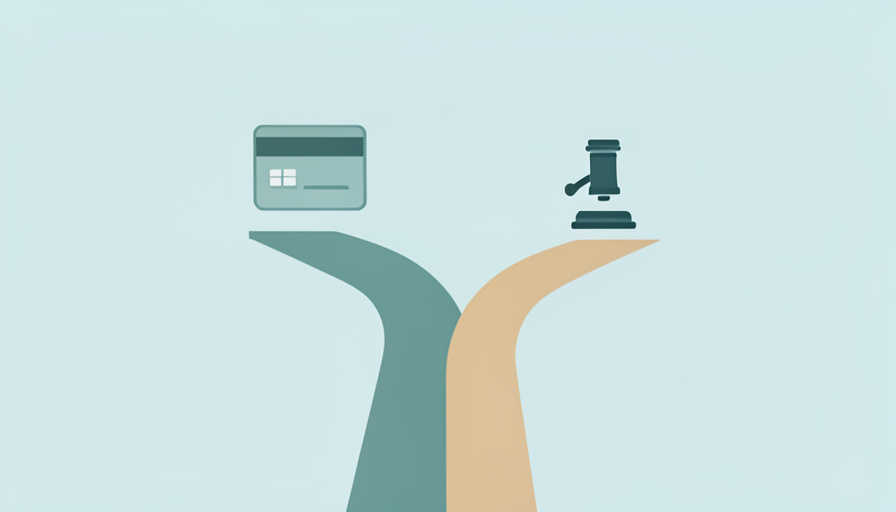
You paid a deposit, the job never happened, and now the company won’t answer your calls. Or the product showed up broken and “all sales are final” is suddenly the only sentence they know. You are owed money, and you have two real ways to force the issue. The trick is knowing which one to reach for, and in what order.
The small claims vs chargeback question comes up constantly, because both are genuine consumer tools and they work in completely different ways. A chargeback runs through your bank; small claims runs through a court. One is fast and free but limited to card payments and time windows, the other works for almost any dispute but takes real effort. Here is how to choose without wasting the good option on the wrong problem.
Bottom Line First
If you paid by credit or debit card and you are inside the time window, start with a chargeback: it is faster, free, and does not require the merchant to cooperate. Use small claims court when a chargeback is not available or has failed, when you paid by cash, check, or bank transfer, or when the amount is large and within your state’s small claims limit. Try a direct written refund request first, since both tools work better with a paper trail.
What a Chargeback Actually Is
A chargeback is a payment reversal you request from your card issuer, not from the merchant. If the bank agrees you have a valid dispute, it pulls the money back out of the business’s account and returns it to you. You are using the protections built into the card networks, which is why it works even when the company is ignoring you completely.
The catch is that chargebacks only apply to card payments, and they come with deadlines, commonly around 60 to 120 days from the transaction or the expected delivery date, depending on the network and the reason. As consumer guides like this overview of refund options note, banks also expect you to have tried to resolve it with the merchant first. So a chargeback is powerful, but it is a use-it-or-lose-it tool tied to how and when you paid.
What Small Claims Court Actually Is
Small claims court is a simplified court for money disputes under a dollar limit that varies by state, often somewhere between roughly $2,500 and $10,000 or more. You do not need a lawyer, the filing fees are modest, and the process is built for regular people to argue their own case in front of a judge.
Its big advantage is reach. It does not care how you paid, so it works for cash, check, bank transfer, or a card dispute that already failed. Its big disadvantage is effort and collection: you have to file, show up, and if you win, you may still have to chase the business to actually pay. A judgment is an order, not a check. Still, for a real amount of money and a business that is stonewalling, it is the tool with teeth.
How to Decide Between Them
Line up the two against your specific situation and the answer usually falls out quickly.
| Factor | Chargeback | Small Claims Court |
|---|---|---|
| Payment method | Credit or debit card only | Any (cash, check, transfer, card) |
| Cost to you | Free | Modest filing fee |
| Speed | Days to a couple of months | Weeks to months |
| Time limit | Tight (often 60 to 120 days) | Longer (state statute of limitations) |
| Effort | Low (a form and evidence) | Higher (file, appear, argue) |
| Getting paid | Automatic if you win | You may have to enforce it |
| Amount | Any, up to the charge | Up to your state’s limit |
The short logic: card payment, recent, and you want it handled fast, file the chargeback. Non-card payment, a bigger sum, an older problem, or a chargeback that already went the merchant’s way, look at small claims.
The Order That Works Best
You rarely have to pick blind, because these tools stack in a sensible sequence. Working through them in order also builds the exact record each later step wants to see.
- Ask in writing first. Send a clear, dated refund request by email or message and keep the reply. This alone sometimes works, and it is evidence for whatever comes next.
- File the chargeback if you paid by card. Do it while you are inside the time window. Attach your receipts, messages, and the failed refund request.
- Send a demand letter if the chargeback fails or does not apply. A short letter stating what you are owed and that you will file in small claims often prompts payment on its own.
- File in small claims as the backstop. When nothing else moves the money and the amount justifies the effort, this is where you go.
The Traps to Watch For
A few things quietly derail people. The first is missing the chargeback window: card disputes expire, so a card payment you sit on for six months may lose its easiest remedy. Act while the clock is still running.
The second is the arbitration clause. Many contracts, especially for phone, cable, internet, and some services, include a clause that says disputes go to private arbitration instead of court, which can limit or block a small claims filing. Read the agreement before you count on suing. And do not treat a chargeback as a casual “undo” on a purchase you simply regret; a chargeback is for a genuine dispute where the merchant failed to deliver or refused a legitimate refund, and filing frivolous ones can get your card account flagged.
Key Takeaways
- A chargeback is a bank-run payment reversal for card purchases; it is fast, free, and works even if the merchant ignores you, but it has tight deadlines.
- Small claims court works for any payment method and larger sums up to your state’s limit, without a lawyer, but takes more effort and you may have to enforce a win.
- Start with a written refund request, then a chargeback if you paid by card and are in the time window.
- Move to a demand letter and then small claims if the chargeback fails, does not apply, or you paid in cash or by transfer.
- Watch two traps: the chargeback deadline, and arbitration clauses that can block a small claims filing.
Frequently Asked Questions
Should I do a chargeback or sue in small claims first?
If you paid by card and are within the dispute window, start with a chargeback because it is faster and free. Reserve small claims court for when a chargeback is not available, has already failed, or you paid by cash, check, or transfer. Always send a written refund request first, either way.
Can I file a chargeback and go to small claims for the same purchase?
Generally you pursue them in sequence, not at the same time, and you cannot collect the same money twice. If a chargeback succeeds you are made whole and there is nothing left to sue for. If it fails, small claims becomes your next option, and your chargeback paperwork becomes useful evidence.
How long do I have to file a chargeback?
It varies by card network and dispute reason, but the window is often around 60 to 120 days from the transaction or the expected delivery date. Because it is tight, file promptly rather than waiting. Small claims deadlines are much longer, set by your state’s statute of limitations.
What if the contract has an arbitration clause?
An arbitration clause can require you to resolve the dispute through private arbitration instead of small claims court, and these are common in phone, internet, and some service contracts. Read your agreement before relying on suing. A chargeback, which runs through your bank rather than the courts, is often unaffected by such clauses.
Final Takeaway
When a business refuses to give your money back, you are not stuck, you just have to aim the right tool at the problem. Reach for a chargeback when you paid by card and the clock is fresh, and keep small claims court in reserve for cash deals, bigger amounts, and stonewalling that a bank cannot fix. Build a paper trail from the first message and each step gets easier. For more consumer guidance, see our Law and Finance & Money sections.
This article is general consumer information, not legal or financial advice. Small claims limits, deadlines, and chargeback rules vary by state and card issuer. For a specific dispute, check your card agreement and your local court’s rules, or consult a qualified professional.



Leave a Reply
You must be logged in to post a comment.