


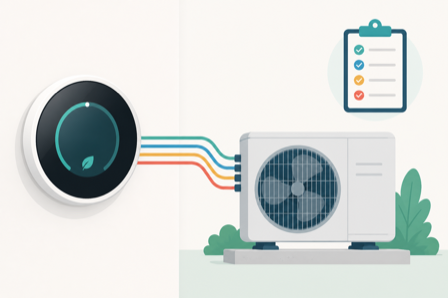
A smart thermostat that ran your neighbor’s gas furnace without a hitch can behave strangely on a heat pump. The reason is that a heat pump does more than a basic furnace: it reverses to heat or cool, and it usually leans on a second, backup heat source when it gets cold. That means more wires, more settings, and more ways for a mismatch to leave you cold, run up your electric bill, or in the worst case stress the equipment. On the HVAC forums, most smart-thermostat questions from heat pump owners come down to the same thing: which wire goes where, and will this thermostat even handle my setup.
The fix is to check compatibility before you buy, not after the old thermostat is off the wall and you are staring at a fistful of colored wires. Run through the checks below and you will know whether a given smart thermostat fits your system, and where you might need an adapter or a call to a pro.
The Quick Version
Before buying a smart thermostat for a heat pump, confirm five things: you have a C-wire (or a supported workaround) for continuous power, the thermostat controls an O/B reversing valve, it supports the number of auxiliary and emergency heat stages your system has, it can handle dual-fuel if you have a furnace as backup, and your system is standard 24-volt low voltage rather than line-voltage baseboard. Match all five and almost any major smart thermostat will work. Miss one, especially aux-heat stages or dual-fuel, and the thermostat can run the wrong heat source at the wrong time.
Why Heat Pumps Make Thermostat Compatibility Trickier
A heat pump moves heat instead of burning fuel, and it runs the same compressor for both heating and cooling. A component called the reversing valve decides which way the heat flows, and the thermostat controls it through a terminal labeled O or B. That is the first difference from a furnace, which has no reversing valve to worry about.
The second difference is backup heat. Per ENERGY STAR, a heat pump works well in the cold but heats your home most efficiently when it is paired with a backup source for the coldest stretches. That backup is usually electric resistance strips or, in a dual-fuel system, a gas or oil furnace. Your thermostat has to know that this heat exists, when to call for it, and just as importantly when to leave it off, since running the strips more than needed is one of the most common and expensive heat pump mistakes.
The Compatibility Checks to Run Before You Buy
Pull your current thermostat off its base and photograph the wiring, then work down this list. The terminal letters are printed on the base plate.
| Check | Why it matters |
|---|---|
| Is there a C-wire (common)? | Most smart thermostats need it for steady power; without one you need an adapter or a self-powering model |
| Is there an O or B wire? | That is the reversing valve; the thermostat must control it and be set to O or B to match your equipment |
| How many aux heat stages (W1, W2, Aux)? | Some thermostats support only one backup stage, so a two-stage strip setup needs a model that handles it |
| Is there an E (emergency heat) wire? | Emergency heat forces backup only and bypasses the heat pump; the thermostat should offer that mode |
| Is there a gas or oil furnace as backup? | That is dual-fuel, and the thermostat must manage the switchover between heat pump and furnace |
| Is the system 24-volt low voltage? | Smart thermostats need low-voltage control wiring, not line-voltage baseboard or millivolt systems |
The C-wire is the one that trips up the most people. If you do not have one, you have options: a C-wire adapter that ships with several thermostats, running a new common conductor if you have a spare wire in the bundle, or choosing a model designed to power itself without one. Just confirm which path your chosen thermostat supports before you buy.
Aux Heat and Dual-Fuel: Where Mismatches Bite
Auxiliary and emergency heat are where a wrong setting costs real money. Auxiliary heat is the backup that kicks in automatically when the heat pump cannot keep up, while emergency heat is a manual mode that runs the backup alone. A compatible thermostat lets you wire both and, ideally, control when the strips are allowed to run so they do not fire on a mild day. If your system has two stages of backup strips, make sure the thermostat actually supports two aux stages, because some popular models handle only one.
Dual-fuel deserves its own look. In a dual-fuel system, a heat pump is paired with a gas or oil furnace, and the thermostat switches between them at a set outdoor temperature. If that switchover is configured wrong, the system can run both sources at once or lean on the expensive one too early, and in some cases it can stress the equipment. Not every smart thermostat handles dual-fuel natively, and some assume dual-fuel the moment they see wires on certain terminals, so this is a setting to verify carefully or hand to a pro.
When to Bring in an HVAC Pro
If you are comfortable labeling wires and following a compatibility checker, a straightforward heat pump swap is a reasonable DIY job. Call a professional when the wiring does not match any standard diagram, when you have dual-fuel or multi-stage backup heat, when there is no C-wire and no obvious way to add one, or when the system is anything other than standard 24-volt low voltage. A pro can also set the O/B, aux, and switchover options correctly so the strips and furnace only run when they should.
This is general home-improvement guidance, not a substitute for professional advice. Thermostat and HVAC wiring involves electrical connections, and a wrong connection can damage equipment or create a safety hazard. If you are unsure at any step, turn off power to the system and consult a licensed HVAC technician.
Frequently Asked Questions
Do all smart thermostats work with heat pumps?
No. Most major smart thermostats support heat pumps, but they differ in how many auxiliary heat stages they handle and whether they support dual-fuel systems. A basic model might control a single-stage heat pump with one backup stage fine, yet fall short on a two-stage or dual-fuel setup. Always run the maker’s compatibility checker with your actual wiring before buying.
What is the O/B wire on a heat pump thermostat?
The O/B terminal controls the reversing valve, the part that switches a heat pump between heating and cooling. Some systems energize the valve in cooling (O) and others in heating (B), so the thermostat has to be set to match your equipment. If it is set wrong, you get cold air when you call for heat, or the reverse.
Do I need a C-wire for a smart thermostat on a heat pump?
Usually, yes. Most smart thermostats need a C-wire for constant power to run the display and Wi-Fi. Heat pumps do not change that requirement. If you do not have a C-wire, look for a thermostat that includes a C-wire adapter, add a common conductor if a spare wire exists, or pick a model built to run without one.
What is the difference between auxiliary heat and emergency heat?
Auxiliary heat is backup heat that turns on automatically to help the heat pump when it is very cold. Emergency heat is a manual mode you switch on to run the backup by itself, usually because the heat pump has failed. Both rely on the same backup source, but auxiliary is automatic assistance and emergency is a deliberate bypass of the heat pump.
Can the wrong thermostat setting run up my heating bill?
Yes. If the thermostat lets the electric backup strips run when the heat pump could handle the load, or a dual-fuel switchover is set too high, you pay for the expensive heat source more than you need to. Setting the O/B, aux, and switchover options correctly, and using any control that limits strip use, keeps the efficient heat pump doing most of the work.
Before You Buy
Compatibility with a heat pump comes down to a short list: power (C-wire), the reversing valve (O/B), the right number of aux and emergency heat stages, dual-fuel support if you have a furnace, and standard low-voltage wiring. Photograph your current wiring, run the thermostat maker’s compatibility checker against it, and you will avoid the most common surprise, which is a thermostat that heats fine until the first truly cold night and then mishandles the backup. When in doubt on aux or dual-fuel, let a pro set it. For more smart home and HVAC guidance, see our Home Improvement and Tech News sections, and the ENERGY STAR guide to smart thermostats for efficiency basics.